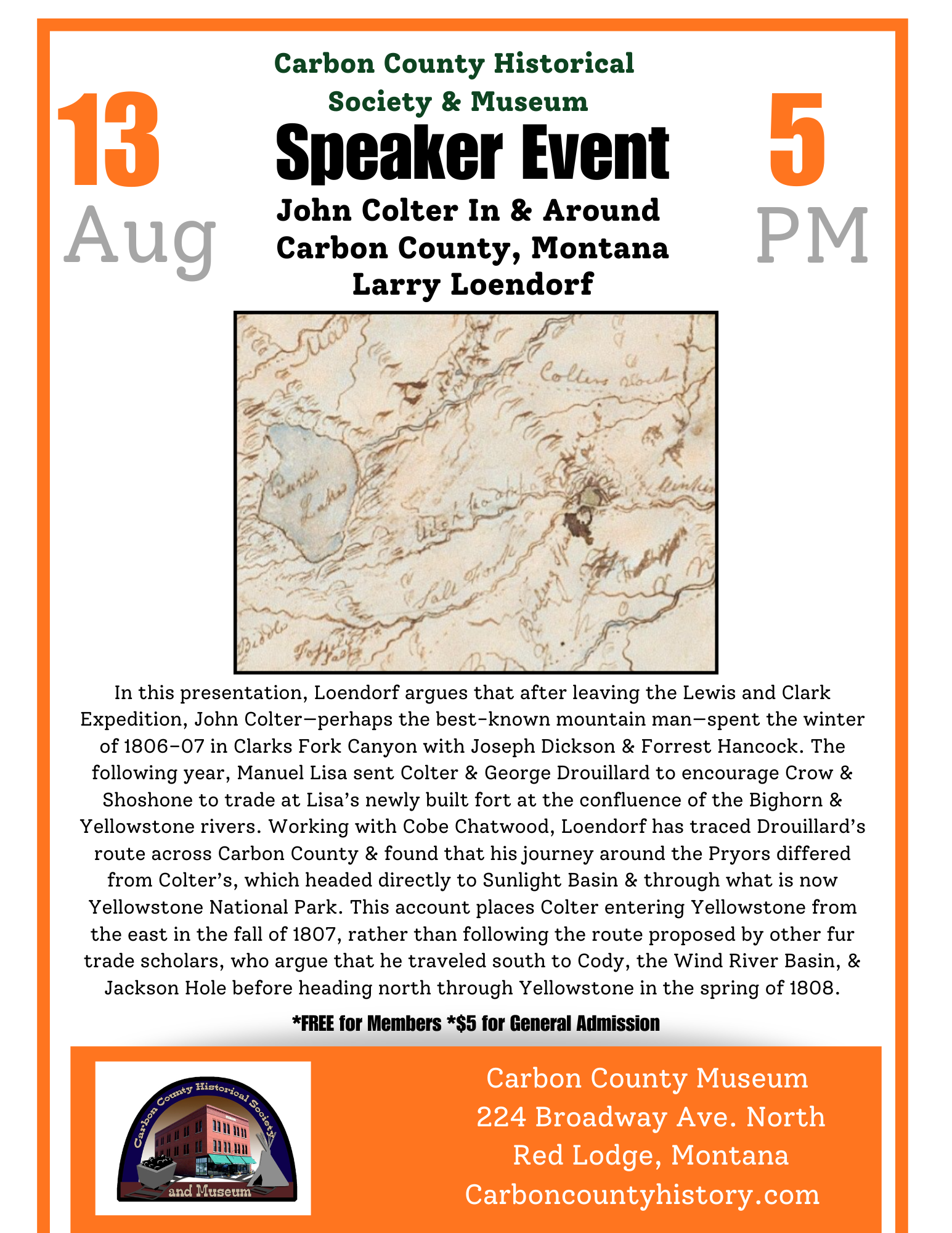
In this presentation, Loendorf argues that after leaving the Lewis and Clark Expedition, John Colter—perhaps the best-known mountain man—spent the winter of 1806–07 in Clarks Fork Canyon with Joseph Dickson & Forrest Hancock. The following year, Manuel Lisa sent Colter & George Drouillard to encourage Crow & Shoshone to trade at Lisa’s newly built fort at the confluence of the Bighorn & Yellowstone rivers. Working with Cobe Chatwood, Loendorf has traced Drouillard’s route across Carbon County & found that his journey around the Pryors differed from Colter’s, which headed directly to Sunlight Basin & through what is now Yellowstone National Park. This account places Colter entering Yellowstone from the east in the fall of 1807, rather than following the route proposed by other fur trade scholars, who argue that he traveled south to Cody, the Wind River Basin, & Jackson Hole before heading north through Yellowstone in the spring of 1808.
Speaker Bio
Lawrence Loendorf is a native Montanan with BA and MA degrees from the University of Montana and a PhD from the University of Missouri Columbia. He taught at the University of North Dakota for 22 years and then at New Mexico State University for 10 years. He currently manages Sacred Sites Research, Inc., a non-profit company. Loendorf is best known for his research at pictograph and petroglyphs sites at locations from Canada to Mexico. His recent research has focused on recording traditional cultural properties, often teaming with American Indians in the process. He has authored or co-authored a dozen books including several on the American Indians in Yellowstone National Park.